

AI-generated answers are now part of how people find information. Google has added AI Overviews into Search, while tools such as ChatGPT and Perplexity have made conversational discovery feel normal for many users.
That attention has created a messy market. Some advice is useful. Plenty arrives packaged as a promise that one tactic or platform can secure AI visibility.
For people already familiar with SEO, the constant stream of opinions can make it harder to separate useful insight from inflated claims.
Let’s separate the terms clearly and evolve your content plan without treating every new acronym as a new strategy.
SEO helps your website appear in traditional search results. AEO focuses on whether your content can be selected as the answer inside a search results page. GEO focuses on whether your brand or information can be included in a response generated by AI tools such as ChatGPT or Perplexity.
They are different types of visibility, but they rely on similar foundations (clear content, information that’s easy to find, useful information and a strong website structure).
Answer engine optimisation (AEO) is concerned with how your content gets selected as the answer inside search-engine results.
That might mean appearing in a:
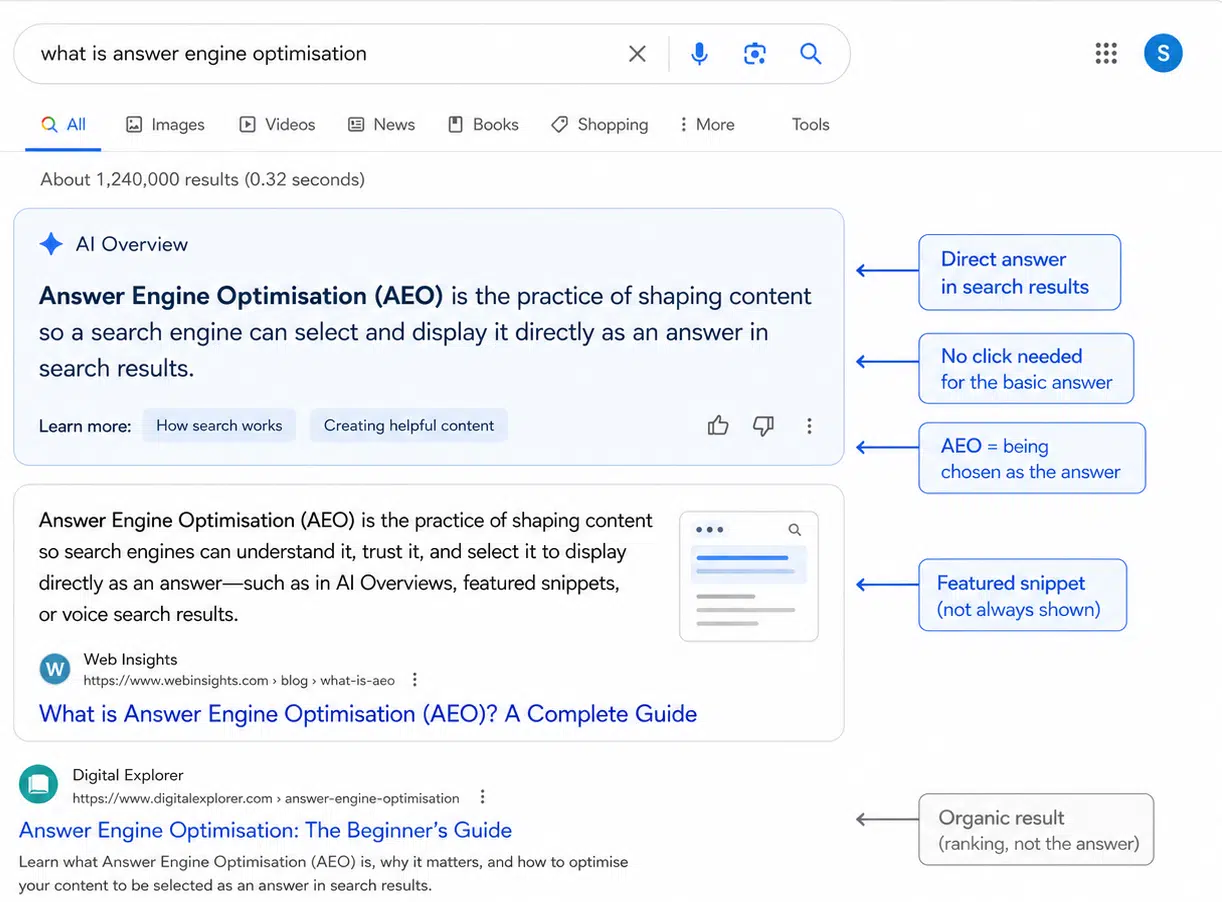
This is not entirely new. Search engines have answered some queries directly for years, through formats such as featured snippets, direct answers and voice search responses. The difference now is that AI is making this answer-led experience more prominent. Google AI Overviews, for example, can synthesise information from different sources and present an answer inside the results page itself.
In each case, the search engine gives the user useful information within the results experience, rather than relying only on a click through to your website.
Search visibility has traditionally focused on ranking. AEO adds the question of whether your content can be used as the answer inside the search results page.
That’s where AEO connects to AI. Search engines are increasingly using AI to shape the answers they show. AEO gives marketers a way to describe the move from only competing for rankings to also being considered for the answer itself.
Generative engine optimisation (GEO) is how your brand appears inside responses created by generative AI systems.
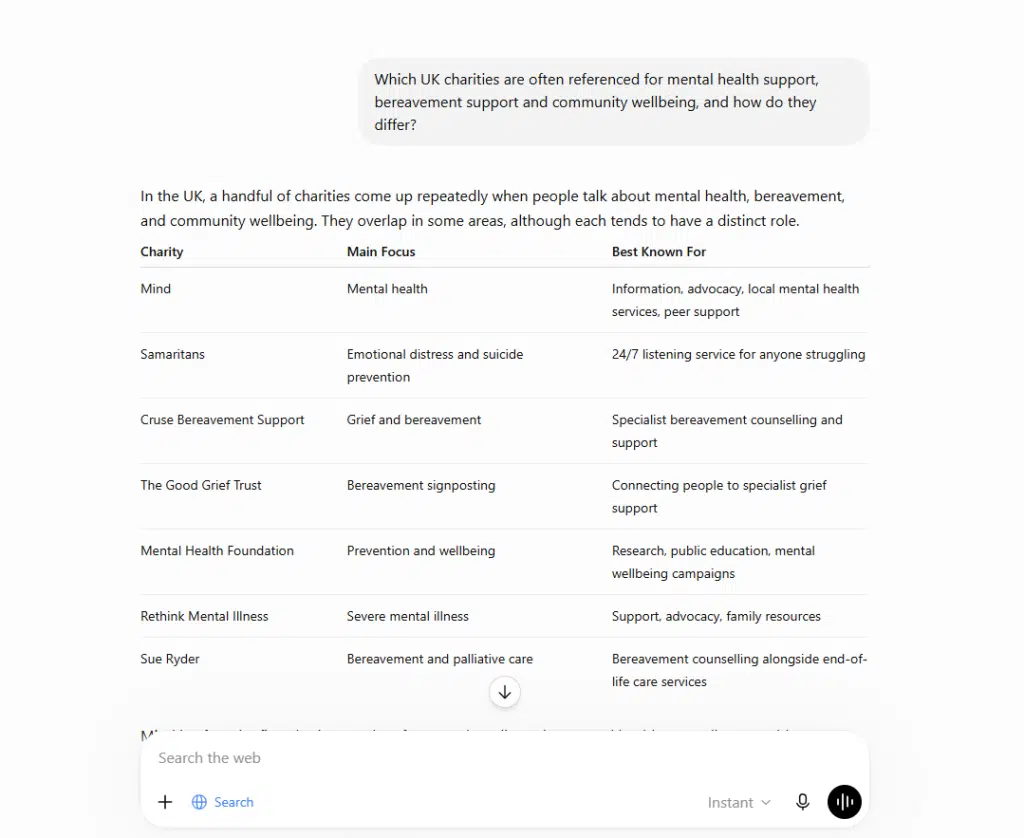
This includes platforms such as ChatGPT and Perplexity, along with other search experiences where the user receives a generated answer rather than a standard list of search results. The answer might pull from several sources, then cite or paraphrase information in a single response.
In GEO, visibility depends on whether your information is clear, relevant, unique and trusted enough to be included in the generated answer itself.
This might mean your brand is cited as a source or used to support the response without the user seeing a conventional search results page.
GEO should be considered as part of your content plan because people are increasingly using generative AI tools to research and make decisions. Your content still needs to be useful, but it also needs to be easy for these systems to interpret and connect to the questions people are asking.
AEO and GEO are often blurred together because both involve answer-led visibility.
The difference is where that visibility happens. AEO is visibility inside search engines, such as appearing in a Google AI Overview or featured snippet. GEO is visibility inside generative AI platforms, such as being referenced in a ChatGPT response.
The content signals might overlap, because both rely on useful and credible information. The distinction is still worth making because it helps you understand where your brand is being surfaced, without treating each channel as a completely separate strategy.
Search engine optimisation (SEO) is the familiar practice of helping pages become discoverable in traditional search results.
SEO is alive and kicking because people still use search engines and content still needs to earn attention once someone lands on the page.
AEO and GEO add new ways for content to be surfaced before, alongside or beyond the click.
This is where SEO becomes the foundation rather than the old model. A page still needs to:
AEO builds on that by asking whether the content can be selected as the answer inside the search results page. GEO builds on it by asking whether the same information can be cited or summarised inside a generative AI response.
The role of SEO has become part of a wider visibility system, where clear, credible content needs to work across traditional search results, answer-led search experiences and generative AI platforms.
Term | Where visibility happens | What it means |
SEO | Traditional search results | Your page is discoverable and earns the visit |
AEO | Search-engine answer features | Your content is used as the answer inside the results page |
GEO | Generative AI platforms | Your brand or information is included in a generated response |
Probably not.
A more useful question is whether your existing content is strong enough to work across all three environments. Search is changing, but that doesn’t mean brands need to rip up their SEO strategy and start again.
Strong SEO foundations are still worth the investment. Your content needs to be discoverable and useful when someone finds it through traditional search. It also needs to be clear enough for search engines to draw answers from it, and credible enough for generative AI systems to reference it in a response.
For instance, one well-structured guide or landing page can support several types of visibility at once. It can help a page rank in search, give a search engine a clear answer to extract and provide source material that may be cited or summarised in an AI-generated response.
The shift towards AEO and GEO can make content feel more technical than it needs to. Search engines and AI tools still depend on content that answers a real question and gives the reader enough confidence to keep going.
Older SEO conversations sometimes separated what helped a page rank from what helped a person engage with it. That distinction is less useful now. Content that solves real problems and is well-structured is usually easier for search engines to understand and easier for AI systems to interpret.
Content still must serve a business purpose. It needs to attract the right audience, raise awareness, support decision-making and build trust in the brand. Making weak content more “AI-friendly” will not fix the underlying problem.
The best starting point is still the reader. When content helps them understand, compare or decide with more confidence, it has a stronger foundation for SEO, AEO and GEO.
SEO, AEO and GEO describe different types of visibility, but they’re not separate worlds. They all rely on content that is useful for people and clear enough for search engines or AI tools to understand.
One practical place to start is schema markup. It can help search engines read key information on your site more clearly, which makes it useful for answer-led search, but it’s not a shortcut into AI results and it’ll not make weak content stronger on its own.
In the next blog, we look at where schema really helps and where it is being oversold.
You can also read the Human-First AI Marketing Playbook to keep learning about how to embed AI in your marketing safely.
Question | Answer |
Is SEO still relevant? | Yes, because search engines still need to discover and understand pages, and users still need useful content once they land on a site.
|
Is AEO the same as GEO? | No. AEO is answer visibility inside search engines. GEO is visibility inside generative AI platforms.
|
Do I need a separate GEO strategy? | Usually no. Start by strengthening useful, well-structured content that can work across search and AI discovery.
|
Can AI Overviews reduce clicks? | Sometimes answer-led results can satisfy simple queries before a click, but visibility still matters because users may click through for deeper detail.
|
How should brands prepare? | Review important pages for clarity, structure, evidence, internal links and usefulness. |